> For the complete documentation index, see [llms.txt](https://knowledgebase.autorabit.com/llms.txt). Markdown versions of documentation pages are available by appending `.md` to page URLs; this page is available as [Markdown](https://knowledgebase.autorabit.com/product-guides/arm/troubleshoot/arm-faqs/common-errors-and-resolutions/not-available-for-deploy-for-this-organization.md).
# Not Available for deploy for this organization
## Error message: Not Available for deploy for this organization
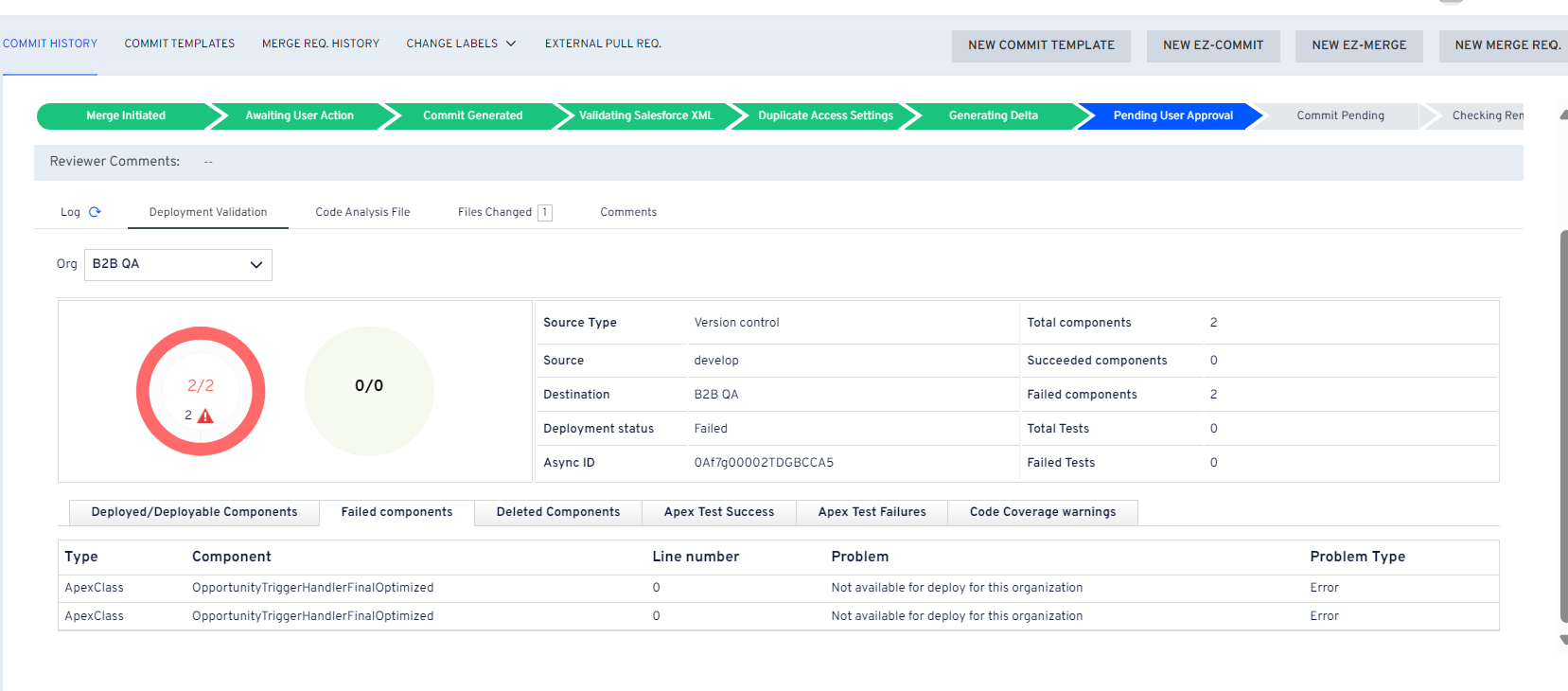
Getting the ''Not Available for deploy for this organization'' error message while deploying the Apex class to the target org can occur when your Salesforce user has an Integration license assigned.
While this license generally allows users to validate and deploy standard or custom objects and fields, it is usually insufficient for deploying most other metadata types. For example, if you are trying to deploy new or updated permissions or custom items like Flows or Apex, the Integration license is likely to result in one of the following two errors:
* "*Insufficient access rights on cross-reference id"*
* *"not available for deploy for this organization*''
**Troubleshooting Steps**
1. Ensure your Salesforce deployment user has all the necessary permissions to deploy the metadata item to the target organization.
2. If you're unsure about which user permission(s) are required for the deployment, we recommend consulting with the administrators who manage the organization’s permissions. They are the best resources to assist you.
3. Check whether both environments being compared are using the same API version. Differences in metadata API versions between the source and target organizations may lead to validation errors.
{% hint style="info" %}
**Note**: *Please note that this error originates from Salesforce rather than AutoRABIT. Nevertheless, we are committed to offering support based on our collective experience with the Metadata API. Our goal is to assist you in navigating this issue and, when possible, help you find a solution. If a resolution is not achievable, we may recommend reaching out to Salesforce support for additional assistance. Thank you for your understanding.*
{% endhint %}
---
# Agent Instructions
This documentation is published with GitBook. GitBook is the documentation platform designed so that both humans and AI agents can read, navigate, and reason over technical content effectively. Learn more at gitbook.com.
## Querying This Documentation
If you need additional information that is not directly available in this page, you can query the documentation by asking a question.
Perform an HTTP GET request on the following URL with the `ask` and `goal` query parameters:
```
GET https://knowledgebase.autorabit.com/product-guides/arm/troubleshoot/arm-faqs/common-errors-and-resolutions/not-available-for-deploy-for-this-organization.md?ask=&goal=
```
`ask` is the immediate question: it should be specific, self-contained, and written in natural language.
`goal` is what the user is ultimately trying to achieve, the reason they need the answer. Sharing it helps GitBook give you a better, more relevant answer. A goal is most helpful when it describes the outcome the user wants rather than restating the question. For example, with `ask=how do I create an API token`, a goal like `automate deployments from our CI pipeline` lets GitBook tailor the answer to that use case.
The response will contain a direct answer to the question and relevant excerpts and sources from the documentation.
Use this mechanism when the answer is not explicitly present in the current page, you need clarification or additional context, or you want to retrieve related documentation sections.