> For the complete documentation index, see [llms.txt](https://knowledgebase.autorabit.com/llms.txt). Markdown versions of documentation pages are available by appending `.md` to page URLs; this page is available as [Markdown](https://knowledgebase.autorabit.com/product-guides/codescan/getting-started/using-codescan/adding-projects-to-codescan/add-a-project-to-codescan-from-salesforce.md).
# Add a project to CodeScan from Salesforce
{% hint style="info" %}
**PLEASE NOTE:** As of September 2025, Salesforce has started to enforce restrictions on the use of Connected Apps. These changes impact AutoRABIT products that connect to your Salesforce environments using the OAuth 2.0 Client Credentials Flow (including CodeScan). [Please see here about how to adjust to these changes.](https://knowledgebase.autorabit.com/fundamentals/announcements/preparing-for-salesforce-connected-app-usage-restrictions)
{% endhint %}
This document guides how to add a Salesforce project to your [CodeScan cloud](https://www.codescan.io/products/cloud/) account and run the analysis.
1. Login into your CodeScan account.
2. Once you log into your CodeScan account, click the **`+`** icon in the top right corner and select **`Analyze new project`**.
3. It takes you to a different window. Choose the **`Organization`** for which you'd like to create a project. Click **`Set Up`**.
4. In the next window, click on **`Add Analysis Project`** option.
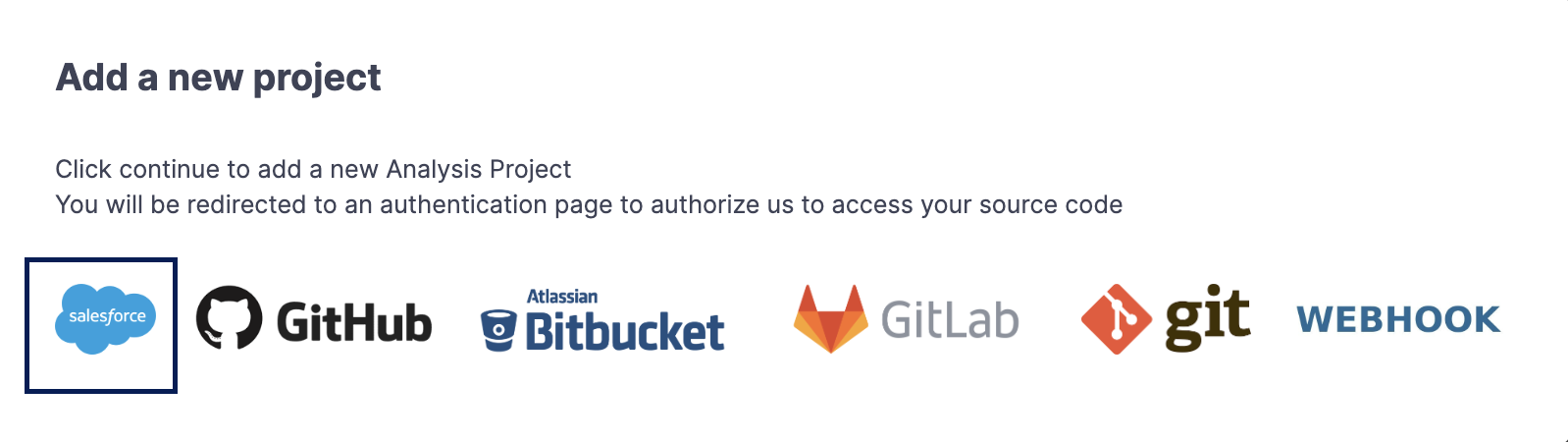
5. You will now see a new popup window; select **`Salesforce`** from the given options.
6. Next, choose the environment from the dropdown between ***Production/Developer**, **My own domain**, and **Sandbox***.
* **`Production/Developer:`** Production/Developer refers authenticating users to Salesforce.com for a Developer account and/or a Production account using the username and password at [*login.salesforce.com*](https://login.salesforce.com/)*.*
* **`Sandbox:`** Sandboxes are test environments that provide a way to copy and create metadata from a production org (above). It is a separate environment where you can test (including seeding with data). There are four different types of sandboxes, accessed at [*test.salesforce.com*](https://test.salesforce.com/)*.*
* **`My own domain:`** Choose this if you have set up your domain or custom URL to access your Salesforce org rather than [*https://login.salesforce.com*](https://login.salesforce.com/). Next, specify the Salesforce login URL in the text box. For example, **. Companies and admins can better manage login and authentication for their Salesforce orgs by creating a custom domain.
7. Click on **`Authorize`**. It will redirect to the Salesforce login page. Validate your credentials and click on **`Login`**.
8. You will be redirected back to the CodeScan app.
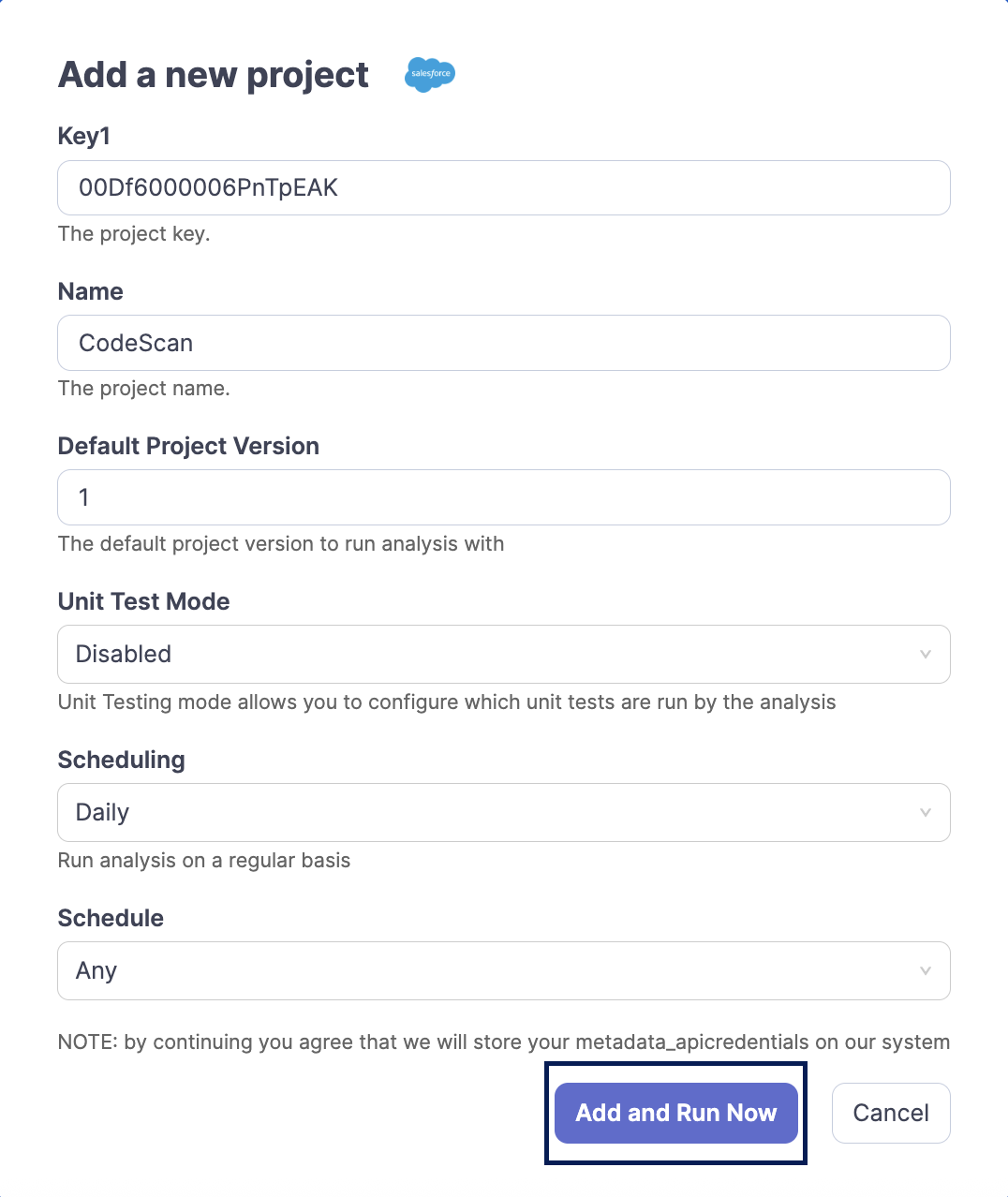
9. In **CodeScan**, on **`Add a new project`** screen, fill in the below details:
* The **`project key`** and the **`project name`** are auto-assigned. You can edit the fields as per your need.Note:To know where to find the project key, refer to our document on how to do it by clicking [HERE](/product-guides/codescan/getting-started/setting-up-a-codescan-cloud-organization/finding-your-project-key.md).
* Enter the project version under the **`Default Project Version`** field.
* Choose the **`Unit Test Mode`** from the dropdown. This allows you to configure which unit tests are run by the analysis. Example, *Run Unit Tests, Use Previous Run, or* keep it in *disabled* mode
* Under **`Scheduling`**, you can set the time frame for the analysis to run. You can run the project automatically by selecting *Daily* or manually by selecting *Manual*. If you select *Daily*, another field named *Schedule* has to be selected by choosing the time you want the automatic analysis to be triggered.
10. Click **`Add and Run Now`**. This triggers the project analysis and the added project under your [CodeScan](https://www.codescan.io/) organization.
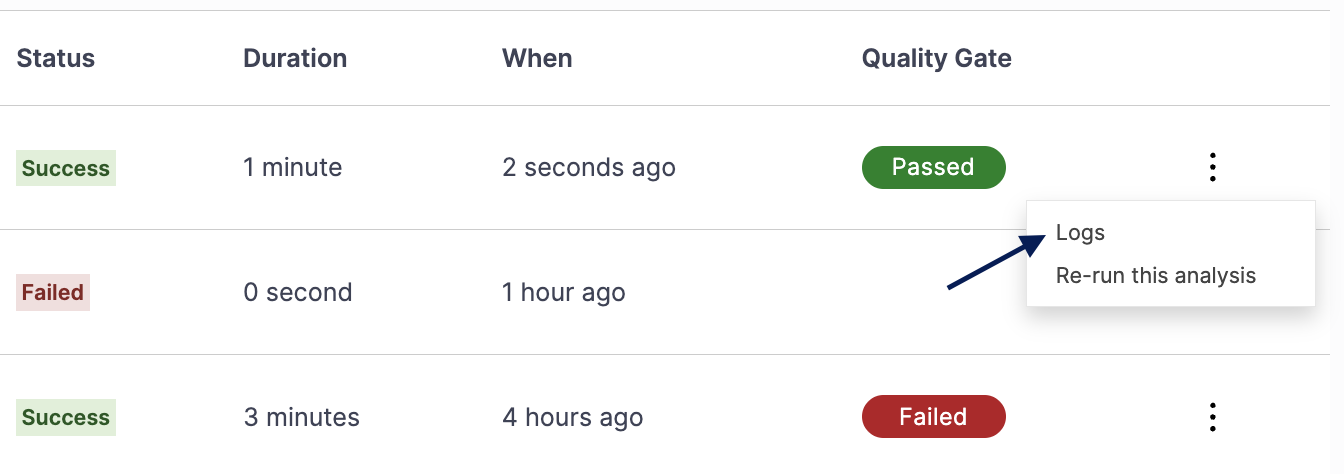
11. You'll be redirected to the **`Project Analysis`** screen to view the status of your analysis triggered.
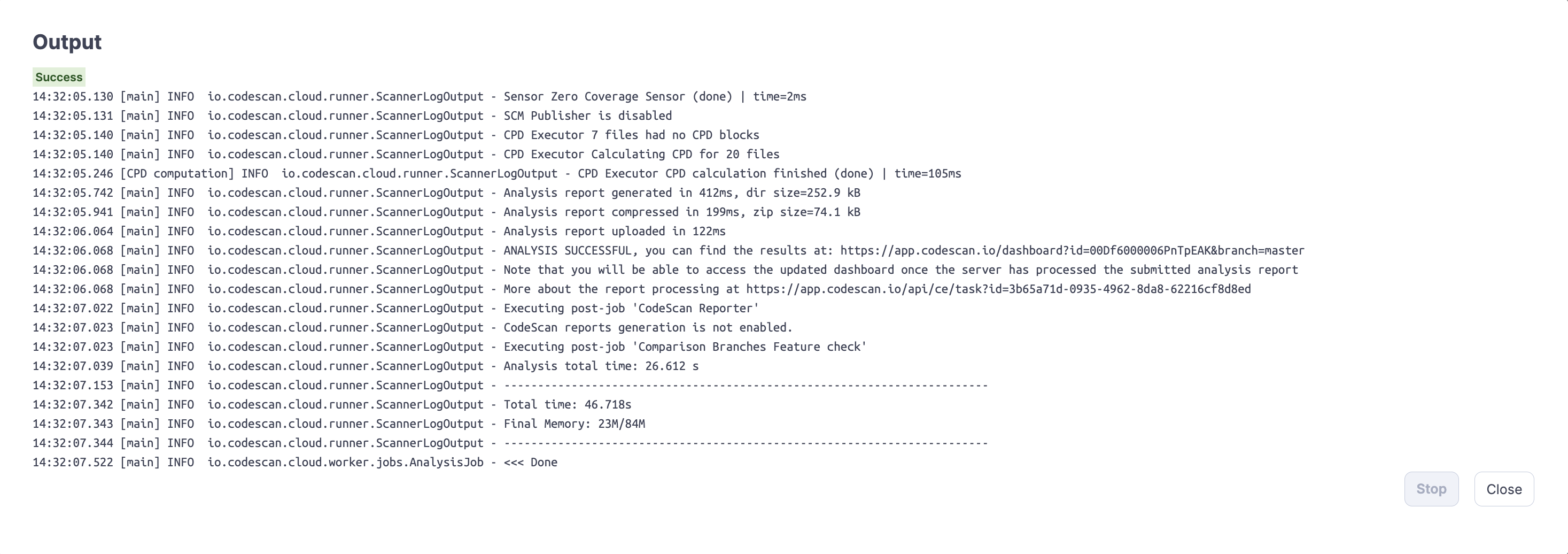
12. View the log report by clicking on more icon drop-down and selecting **`Logs`**.
#### Troubleshooting
**"ip restricted" error:** If your scan fails with the IP restricted error, please refer to the [Troubleshooting article](https://knowledgebase.autorabit.com/fundamentals/faq/codescan-faqs/codescan-cloud-issues/cloud-errors-and-solutions#why-am-i-getting-an-ip-restricted-message).
---
# Agent Instructions
This documentation is published with GitBook. GitBook is the documentation platform designed so that both humans and AI agents can read, navigate, and reason over technical content effectively. Learn more at gitbook.com.
## Querying This Documentation
If you need additional information that is not directly available in this page, you can query the documentation by asking a question.
Perform an HTTP GET request on the following URL with the `ask` and `goal` query parameters:
```
GET https://knowledgebase.autorabit.com/product-guides/codescan/getting-started/using-codescan/adding-projects-to-codescan/add-a-project-to-codescan-from-salesforce.md?ask=&goal=
```
`ask` is the immediate question: it should be specific, self-contained, and written in natural language.
`goal` is what the user is ultimately trying to achieve, the reason they need the answer. Sharing it helps GitBook give you a better, more relevant answer. A goal is most helpful when it describes the outcome the user wants rather than restating the question. For example, with `ask=how do I create an API token`, a goal like `automate deployments from our CI pipeline` lets GitBook tailor the answer to that use case.
The response will contain a direct answer to the question and relevant excerpts and sources from the documentation.
Use this mechanism when the answer is not explicitly present in the current page, you need clarification or additional context, or you want to retrieve related documentation sections.