> For the complete documentation index, see [llms.txt](https://knowledgebase.autorabit.com/llms.txt). Markdown versions of documentation pages are available by appending `.md` to page URLs; this page is available as [Markdown](https://knowledgebase.autorabit.com/product-guides/arm-1/arm-features/ncino/feature-deployment/deployment-via-template-using-salesforce-org-1.md).
# Deployment via Template using Salesforce Org
This article describes the process of deploying the nCino data via the Salesforce ORG dataset
1. A Feature Deployment can be triggered in the following ways:
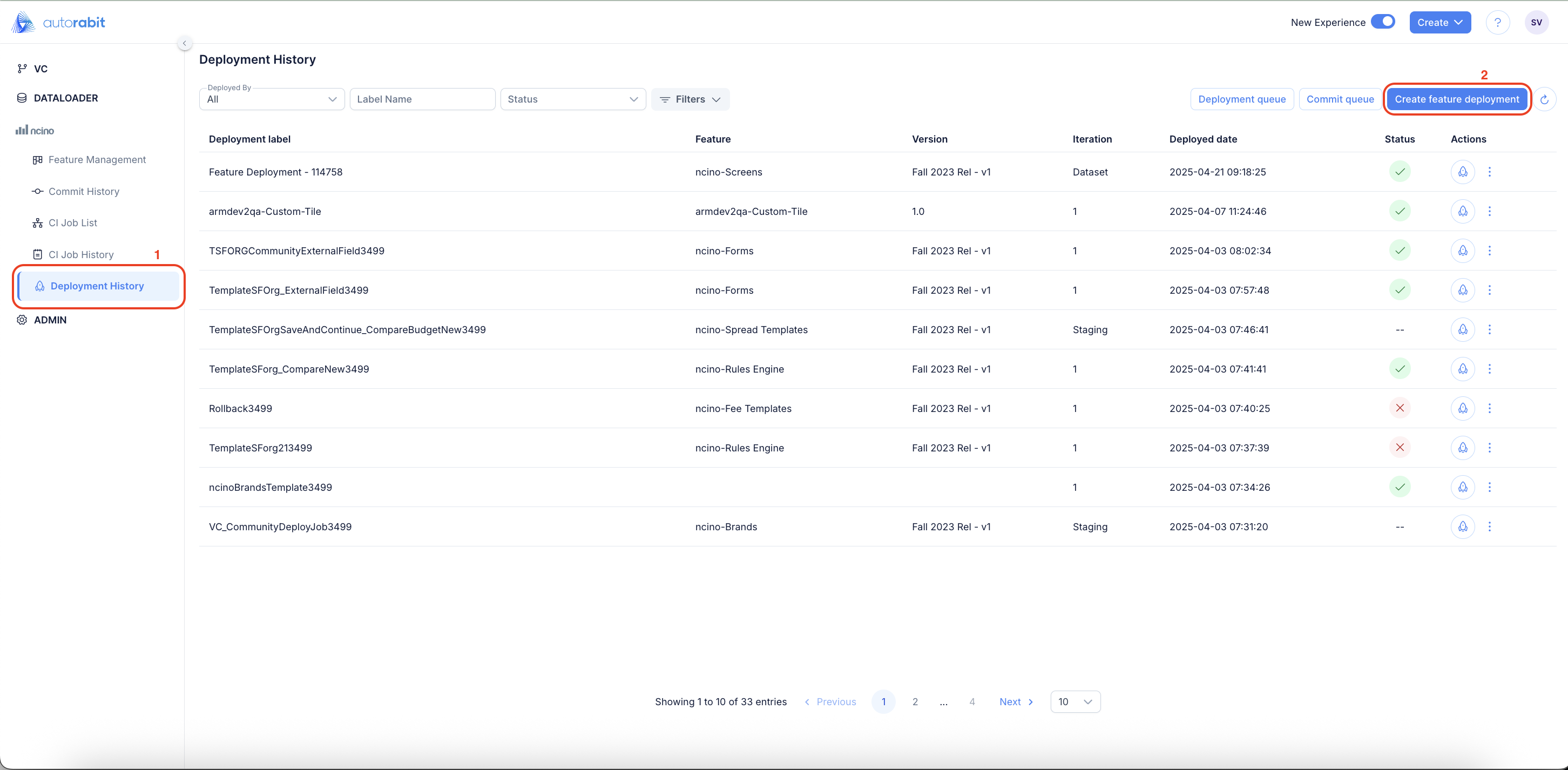
1. Click on the "Create" button to observe the options to select the "Feature Deployment" as an option.
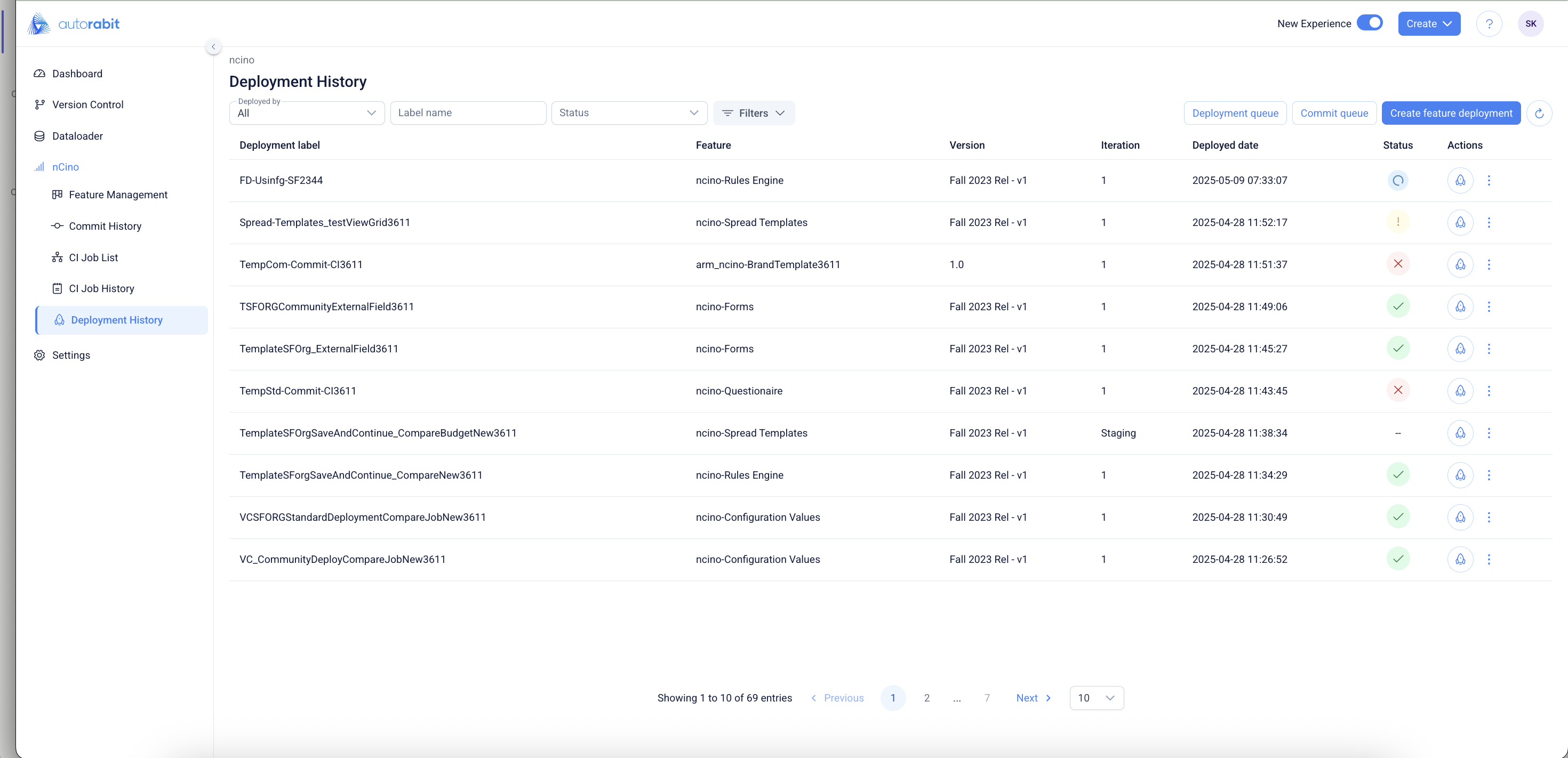
2. Click on the "Deployment History" under the nCino tab to access "Create feature deployment."
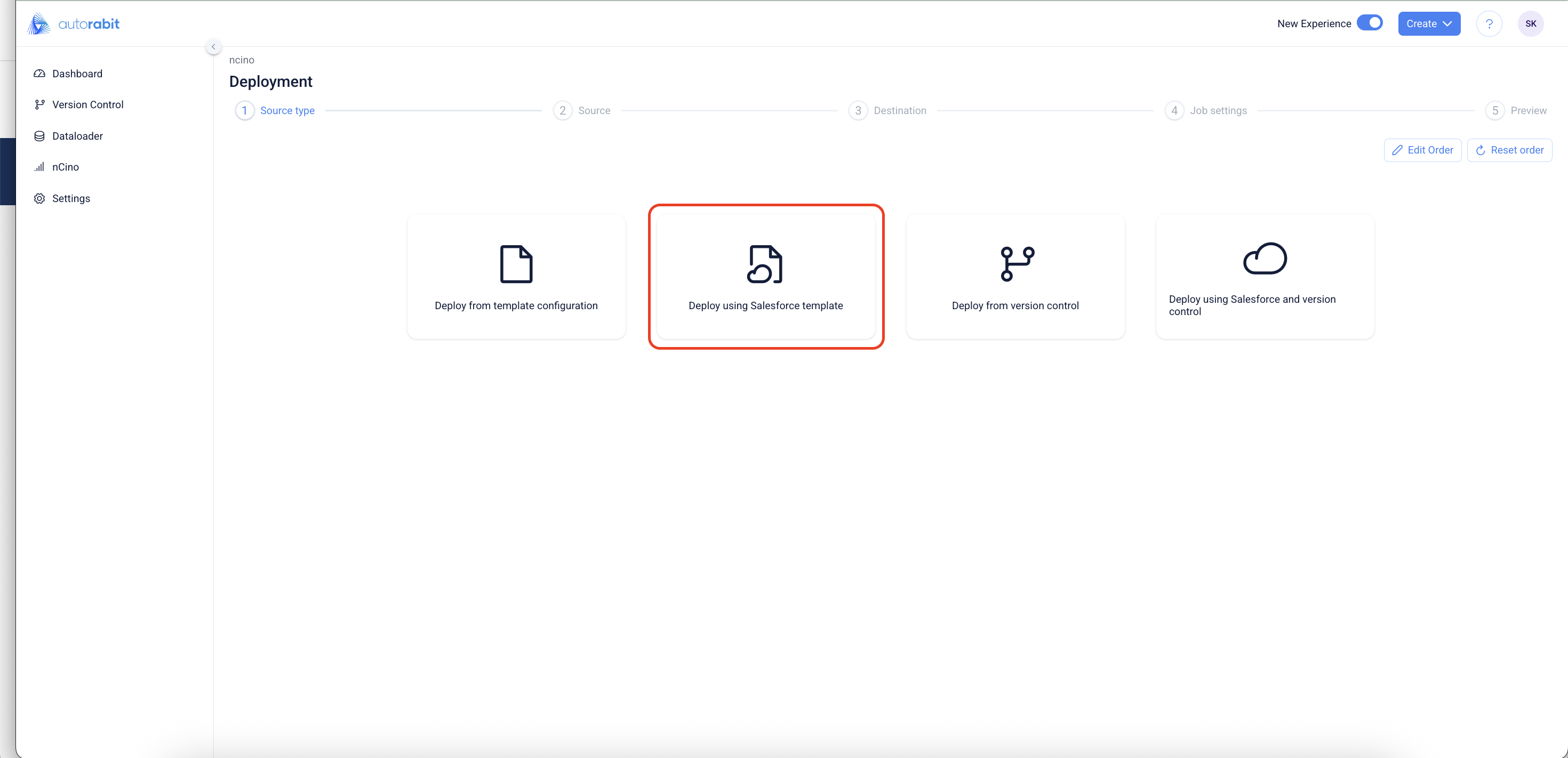
1. Upon clicking on **"Create Feature Deployment"** or selecting the **"Feature Deployment**,**"** a Source Type screen will appear. Choose "**Deploy using Salesforce template**" to proceed.
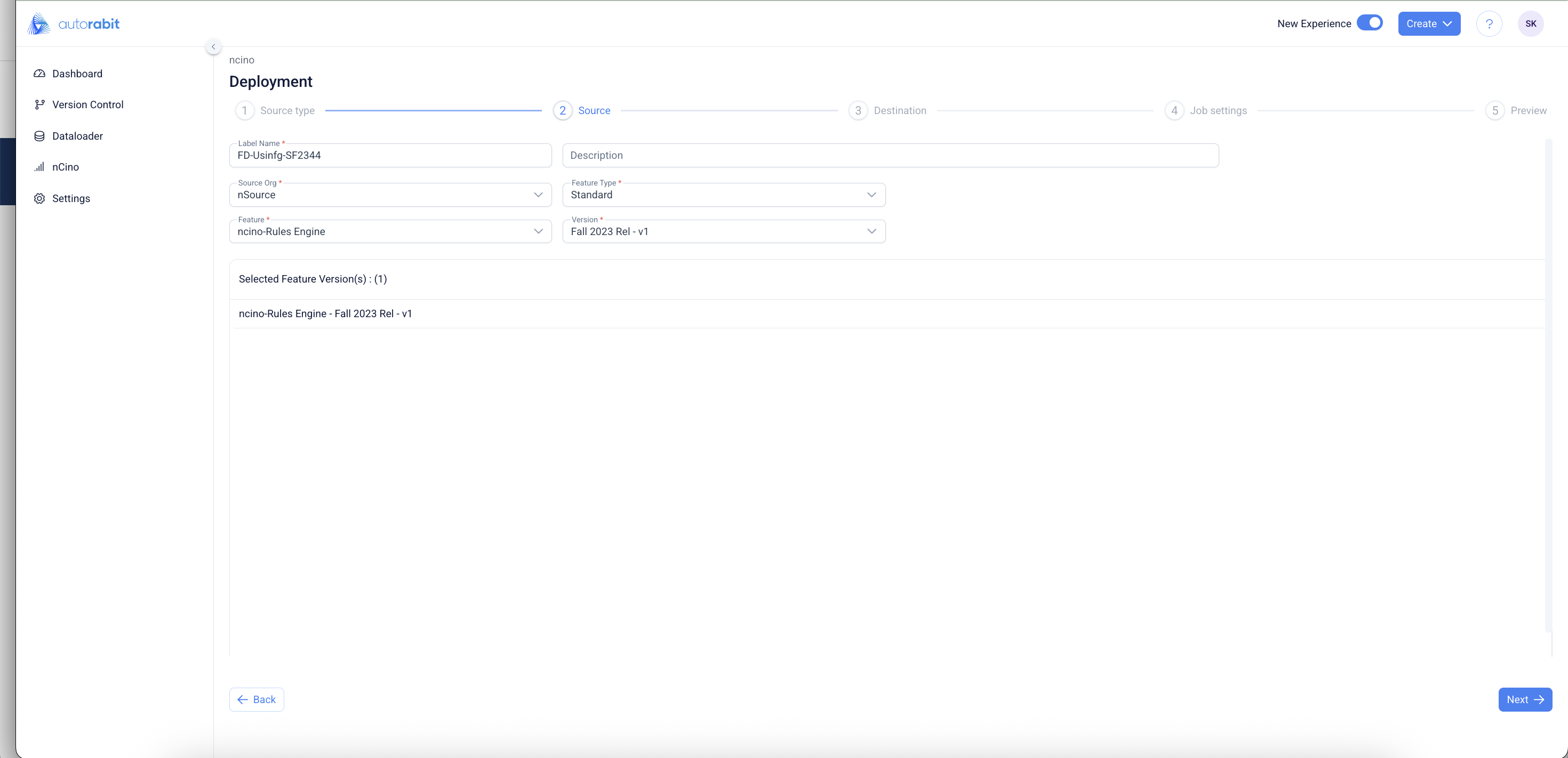
2. Continue to input the fields on the screen with the required inputs.
3. The following fields are available on the screen to input the data:
1. **Label name:** Input label name of the deployment here.
2. **Description:** Enter a description that suits the deployment.
3. **Source Org:** Select the source Org.
4. **Feature Type:** Select the feature type from the available list. The following are the available values:
* Standard
* Community
5. **Feature:** Select the required feature
6. **Version**: Select the version based on the feature selection.
4. After entering all the details, click on '**Next**' to continue to the "**Destination**" screen.
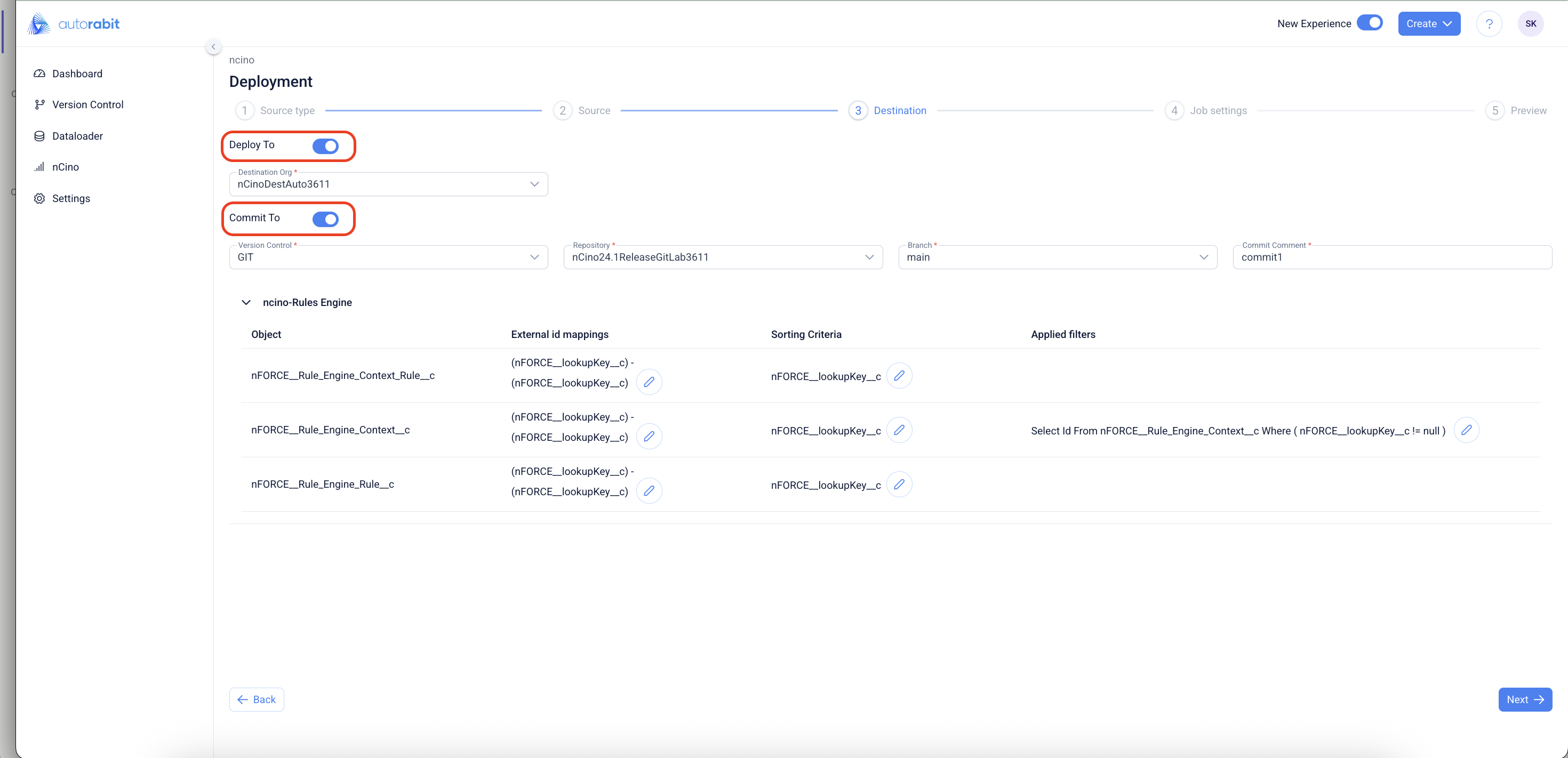
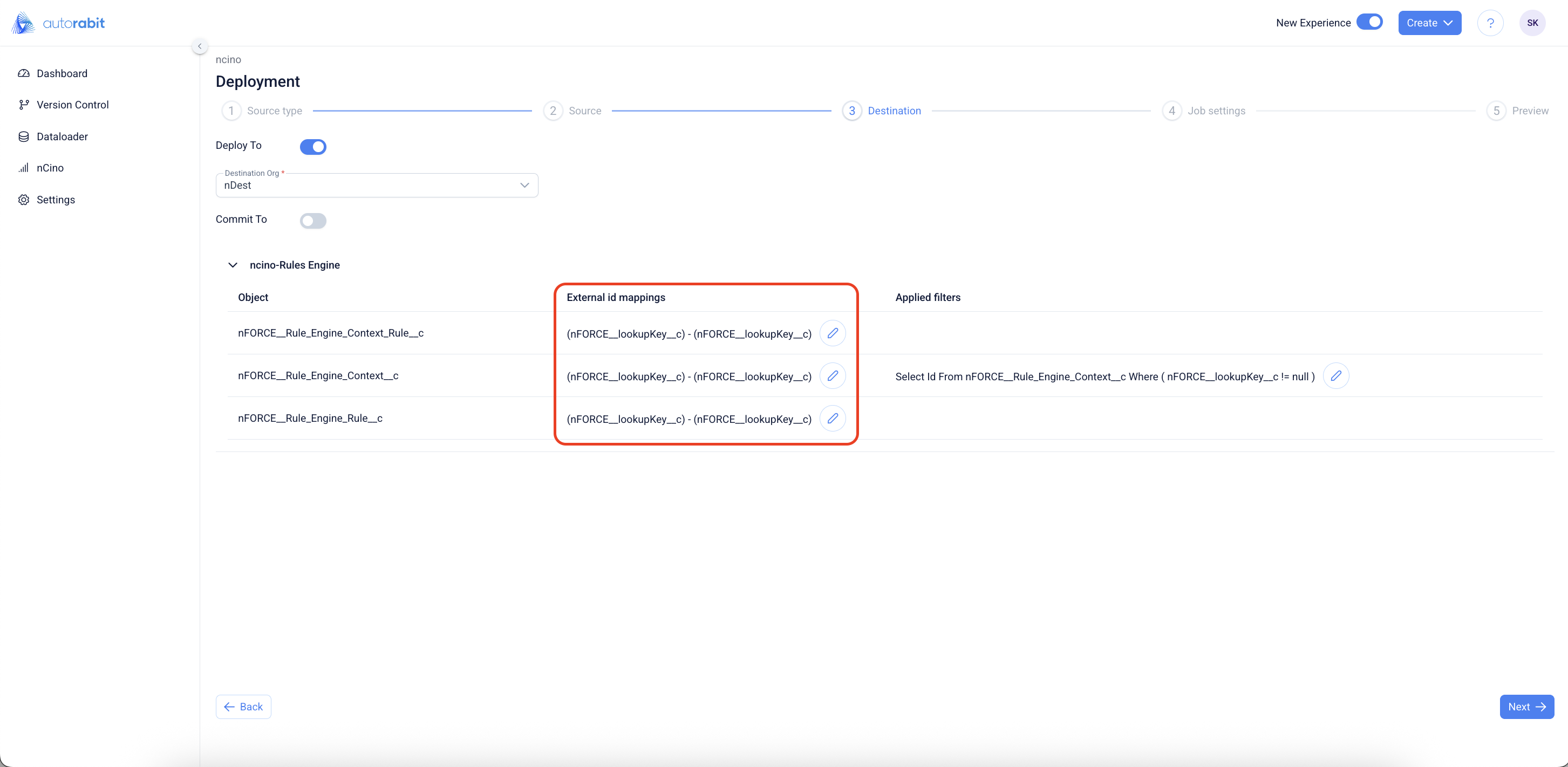
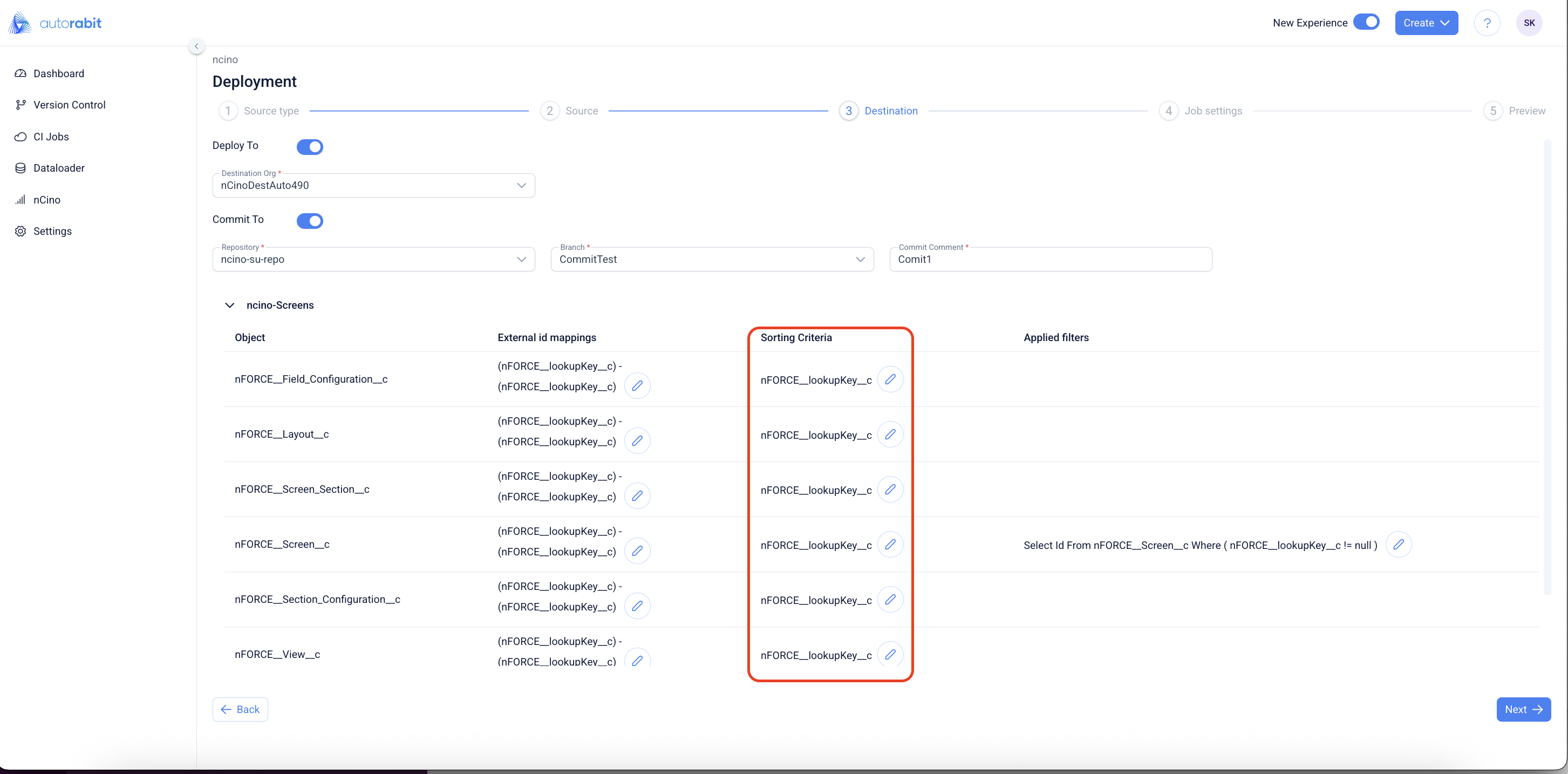
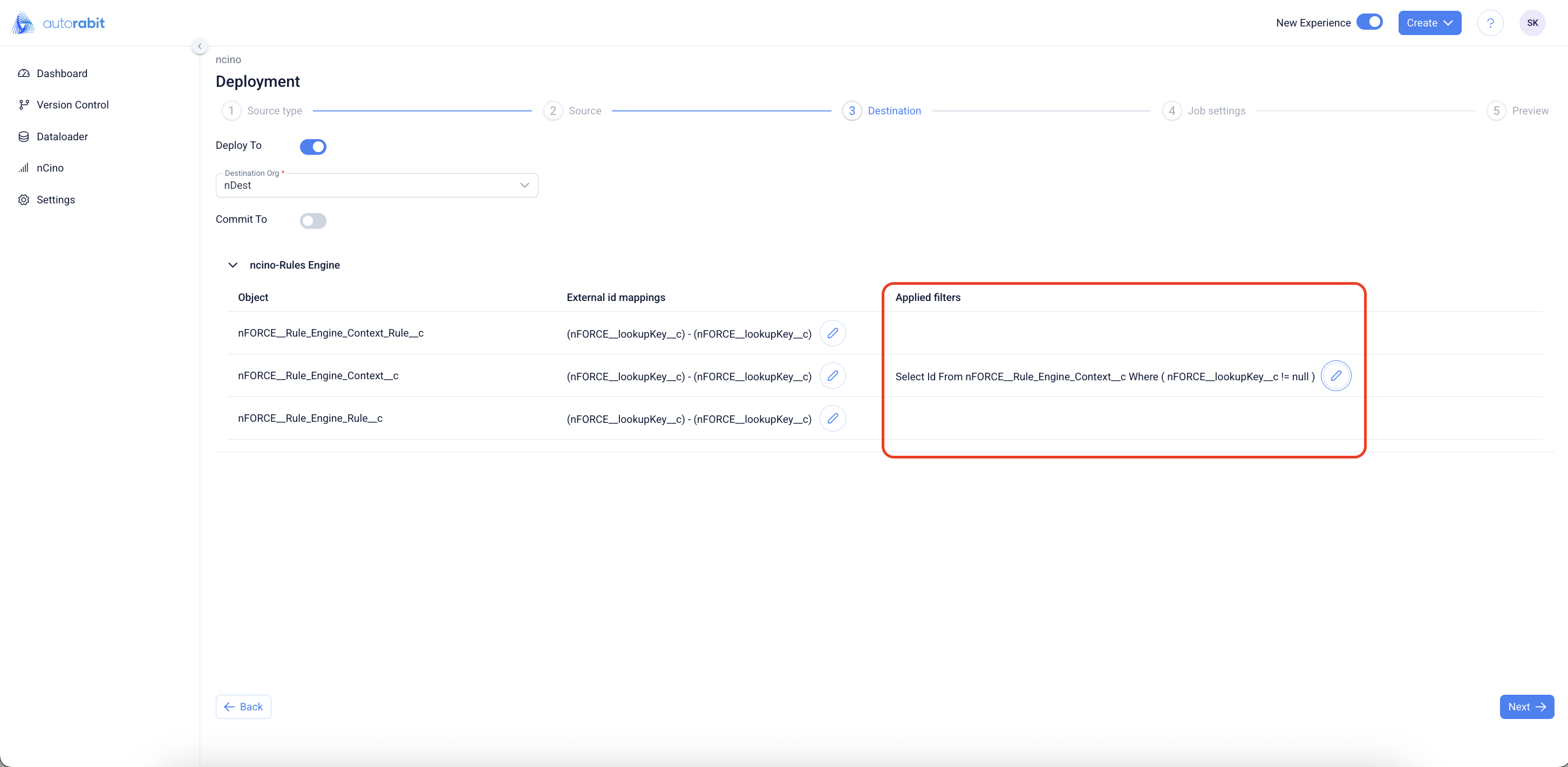
5. Enable "Deploy To" and "Commit To" options on the destination screen. To deploy to a Salesforce org, select the **Deploy To** checkbox and choose your **Destination Org**. To commit to a branch, select the **Commit To** box, enter your **Repository/Branch** details, and **comment** (if any).
{% hint style="info" %}
**Important Note**: For commits, the features will get committed to the default location in your version control branch. By default, the location is set to the dataset.
{% endhint %}
6. The following options can be observed on the data selected for deployment or committing the data:
1. Object: The object selected
2. ExternalId mappings
3. Sorting Criteria (only if the 'Commit to' checkbox is selected)
4. Applied Filters
7. ExternalId Mappings:
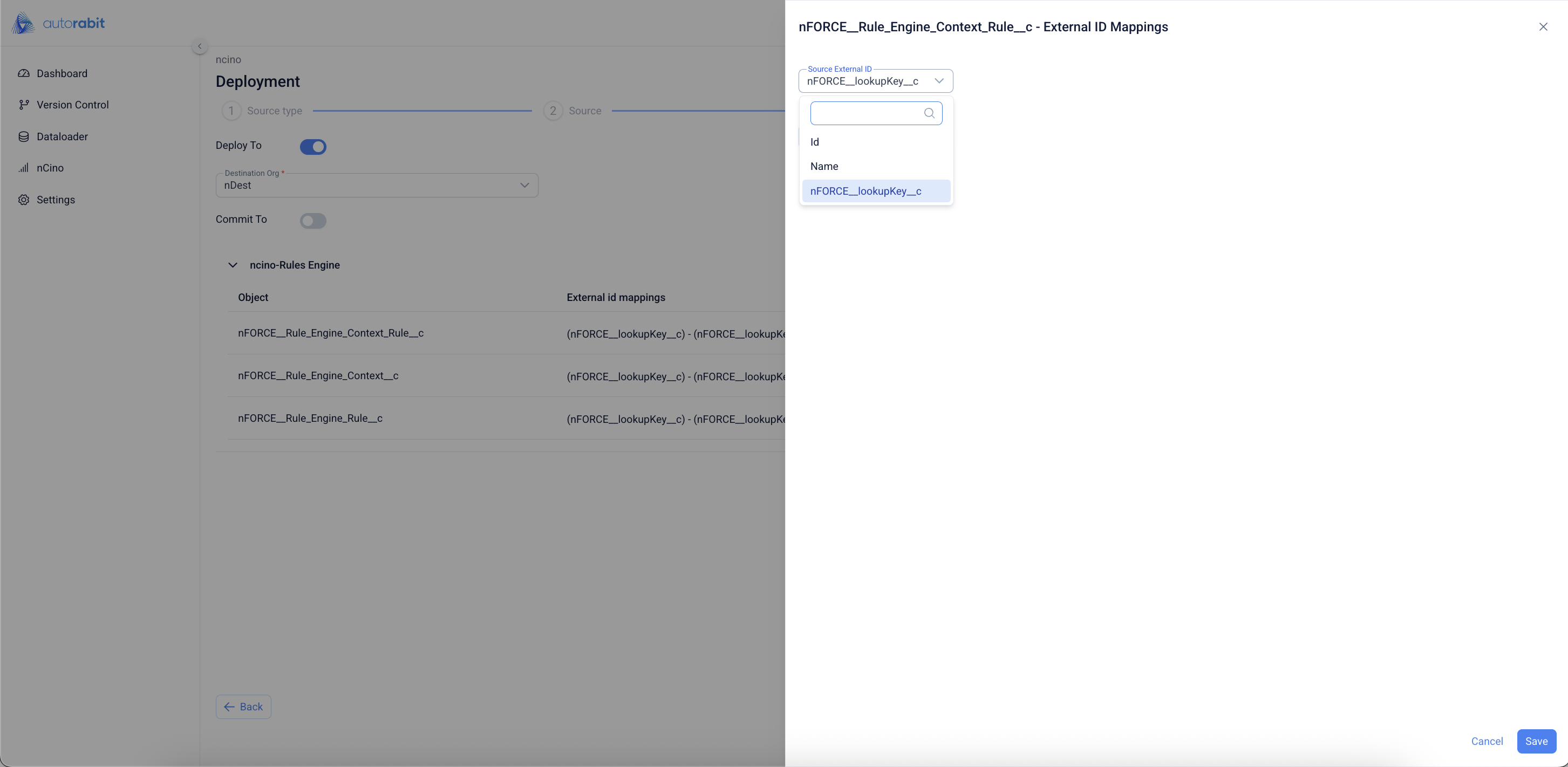
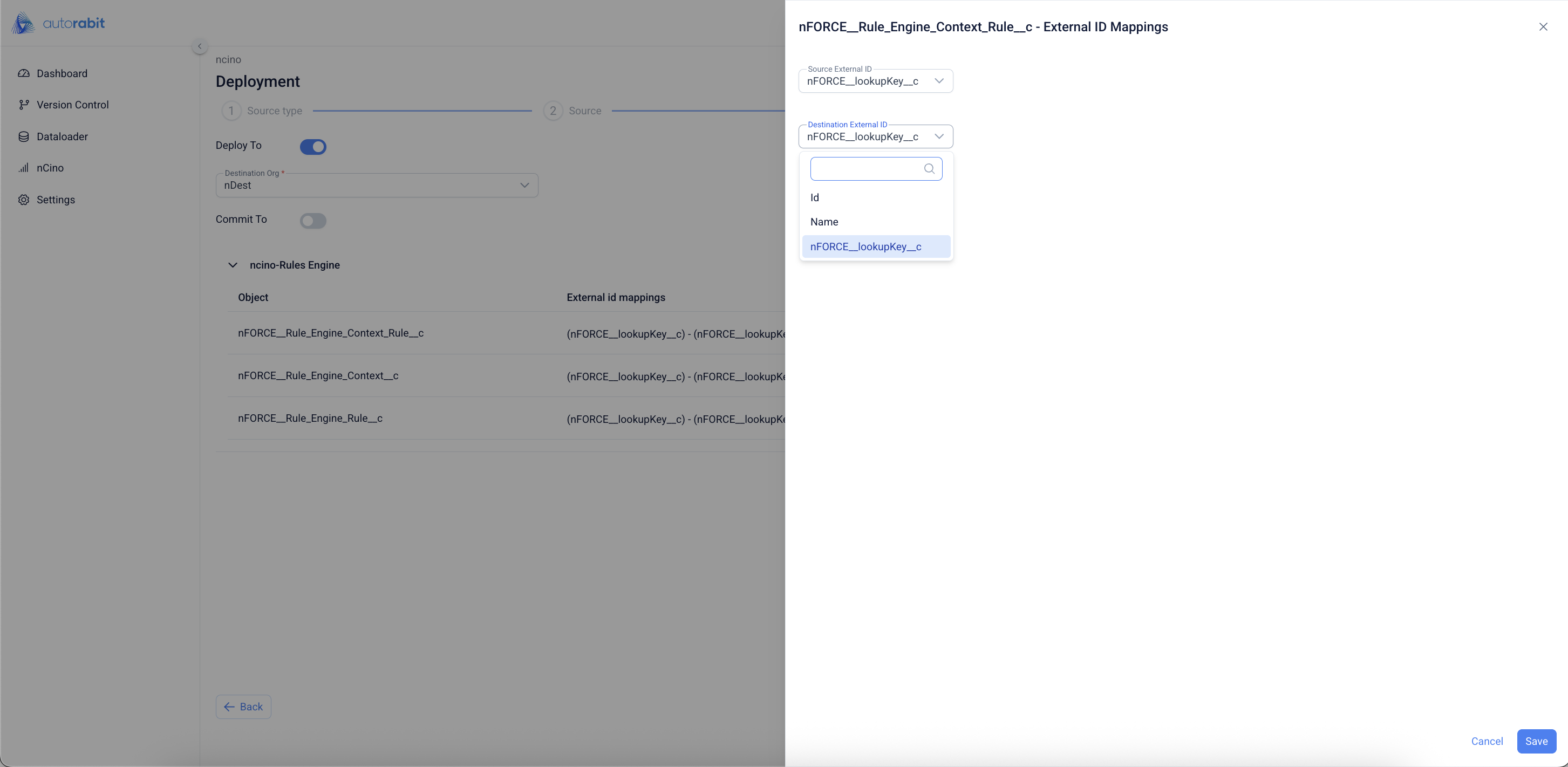
1. This external ID can be used in place of a related record's Salesforce record ID to relate or associate records to each other as you process an Upsert operation. For example, if **Object B** has a lookup field to another **Object A,** you can use the values in a field marked as an External ID on **Object A** to relate the two (**Object B** to **Object A** records).
1. **Source**: Select your source field whose values will be populated in the destination External Id field.
2. **Destination**: Select the required field from the destination org whose values will remain unique for all the records.
{% hint style="info" %}
**Important Note:** (ExternalIdMappings):
1. Since the source for Deployment via **Template** or **Version Control** is a CSV file rather than a Salesforce Org, all fields, regardless of the External ID supported, will be fetched and displayed in the **Source** column. However, the relevant fields will be shown under the Destination column since the target org is a Salesforce org.
2. AutoRABIT External ID fields are not supported for the **Upsert** operation.
{% endhint %}
3. Sorting Criteria: This new feature is useful for sorting the fields of nCino objects while committing. Based on the sort order set, the record order in the JSON files will get fetched. There is a provision to input a default sort order that can be changed. **XXXXX\_lookupkey\_\_c** is the most preferred field for sorting, and that would be the default field. If this field is not present, the **Name** for *custom settings* and **Id** for *non-custom settings* would be selected.
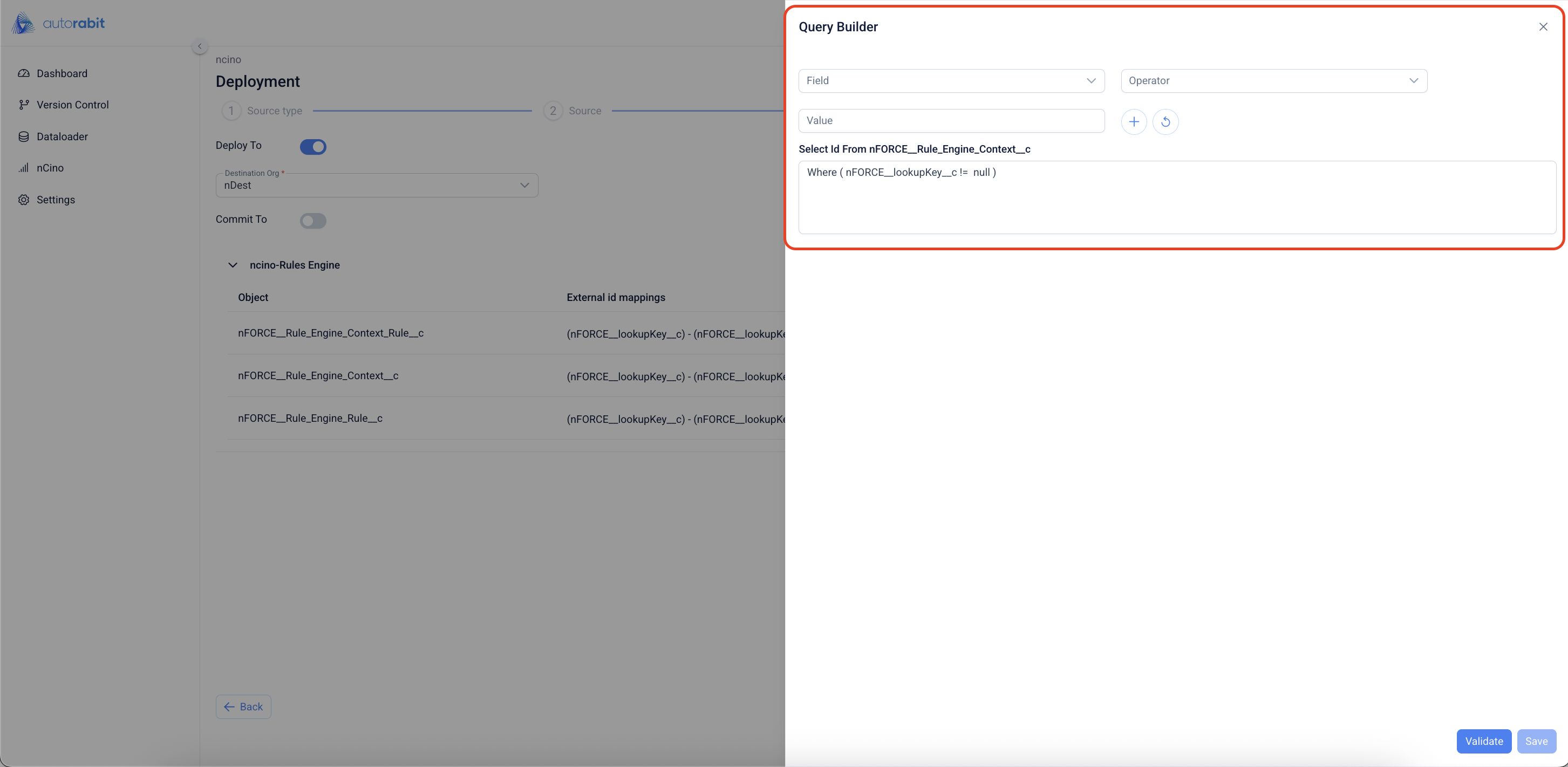
9. **Applied filters**: Such filters will be displayed here if any filter is applied to the objects. You can edit the already applied filter (if required) using **Edit Filter.**
10. After completing the required selections in the "Destination" section, click on "Next" to continue.
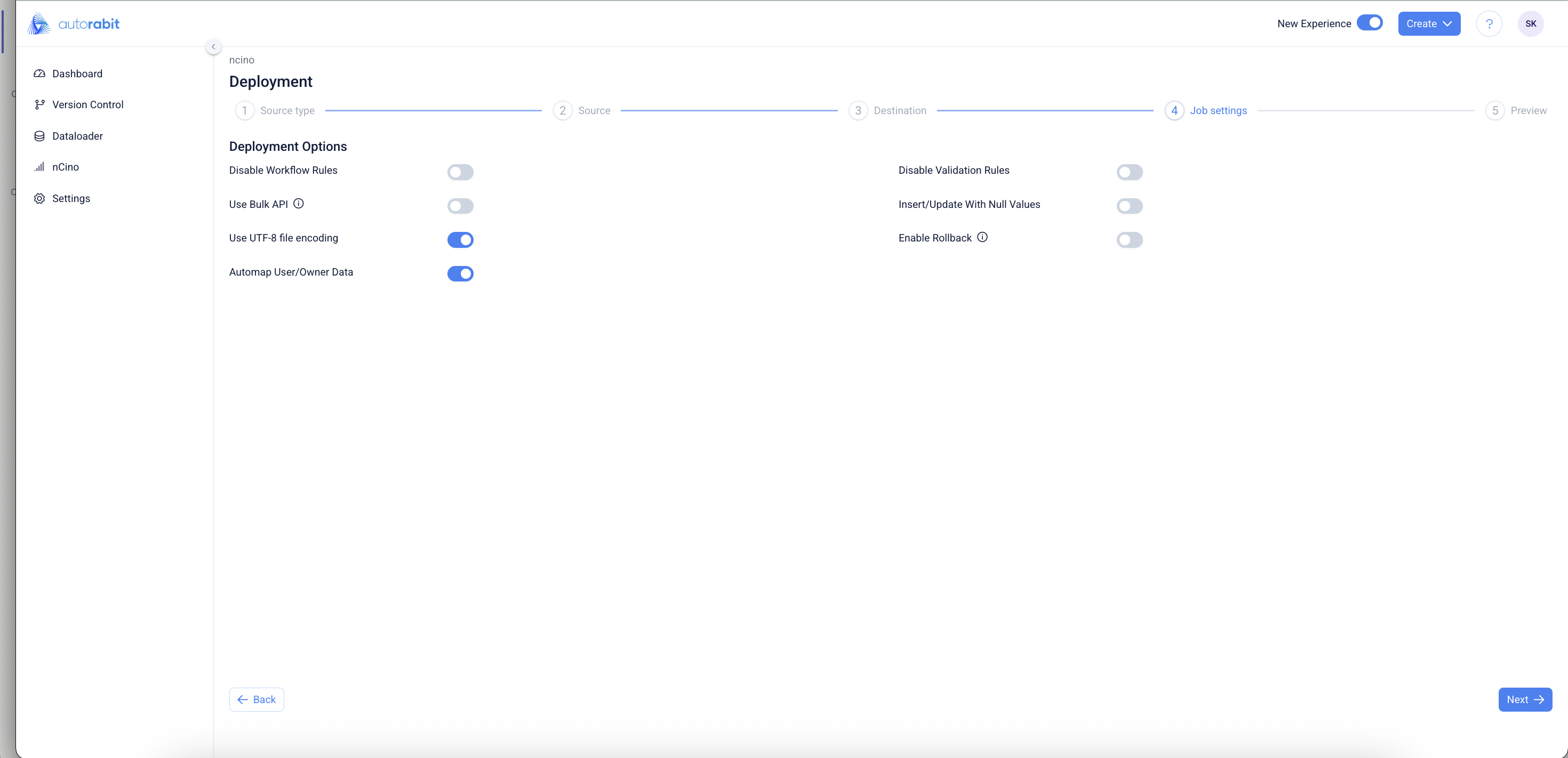
11. **Job settings:** This section provides multiple deployment options to help you configure how changes are pushed to the destination org. You can select from various deployment criteria to tailor the process before initiating the deployment.
12. **Deployment Filters**
1. **Disable Workflow Rules:** This option will deactivate the workflow rules associated with objects part of the deployment.
2. **Use Bulk API (Batch API will be used if the option is not enabled):** You can transfer bulk records all at one time from the source and destination org.
3. **Use UTF-8 file encoding for file read and write operations:** Use UTF-8 as the internal representation of strings. Text is transcoded from the local encoding to UTF-8 when data is written to or read from a file. UTF-8 must be enabled if your data exclusively contains English alphabets. UTF-8 must be disabled if your data contains non-English alphabets. UTF-8 should be enabled by default in accordance with Salesforce.
4. **Automap User/Owner Data**: Enabling this ensures that the user data will be compared between the two environments and will be mapped based on the value before the "@" symbol in the email. On finding the matches, the same user name value will be populated into the fields in the destination. If the user data is sent empty, the user value will be populated with the user registered with our application.
5. **Disable Validation Rules:** This option will deactivate the validation rules associated with objects part of the deployment.
6. **Insert/update with Null Values:** This will either insert or update record field values with null in the destination org (if the value is null in the source org).
7. **Enable Rollback**: Enabling this ensures that the user can roll back the deployment to the previous state before the deployment is initiated.
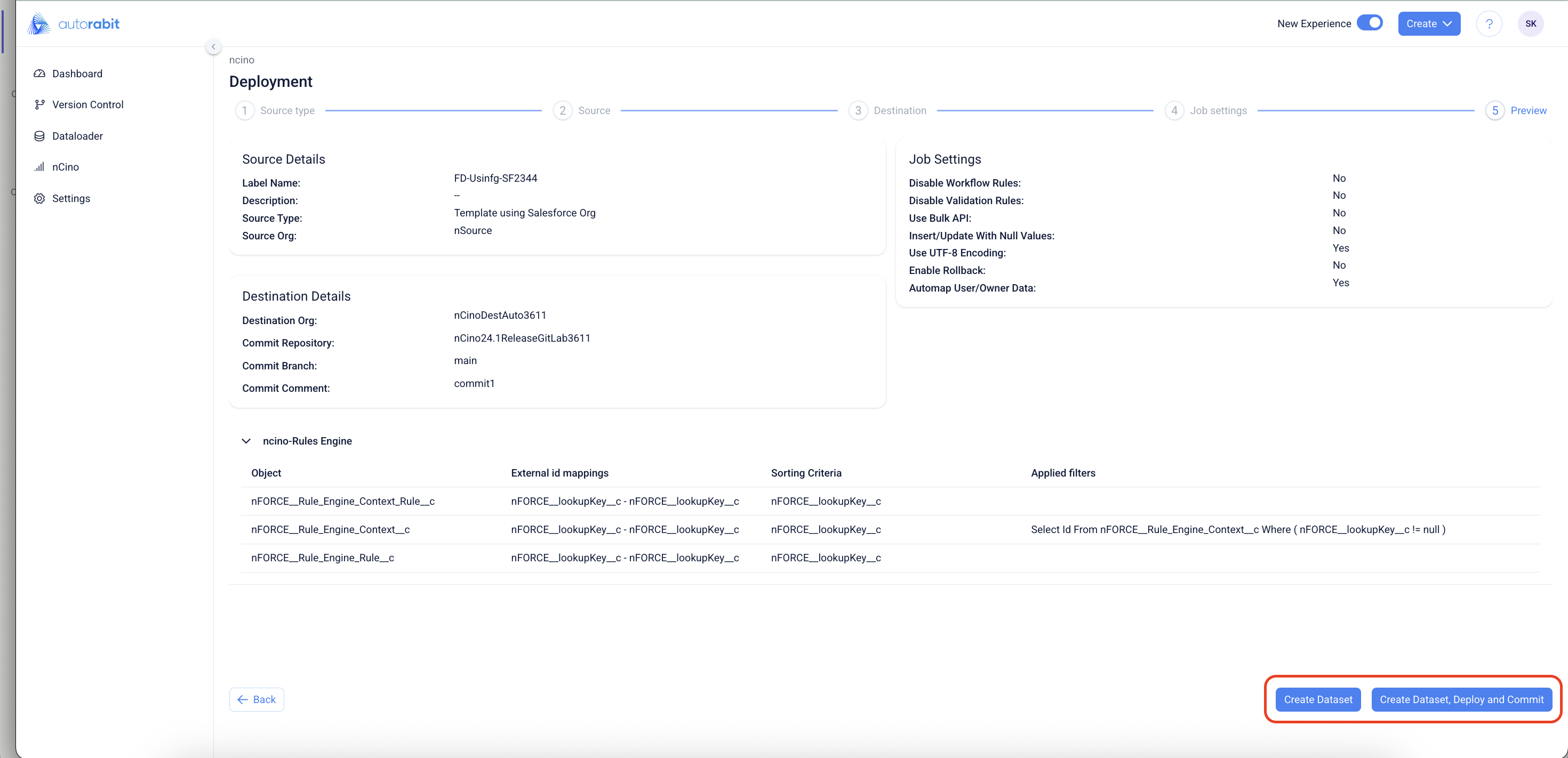
13. **Preview**: All the configurations made during the deployment creation can be observed here, with different deployment options.
13. Based on your destination selection, you will have different deployment buttons to choose from:
1. **Create Dataset:** Create a dataset from your Salesforce Org.
2. **Create Dataset Commit & Deploy:** Create a dataset and proceed for both commit and deployment.
14. Clicking on ether of the deployment options available above, you will be redirected to the "Deployment History" page.
---
# Agent Instructions
This documentation is published with GitBook. GitBook is the documentation platform designed so that both humans and AI agents can read, navigate, and reason over technical content effectively. Learn more at gitbook.com.
## Querying This Documentation
If you need additional information that is not directly available in this page, you can query the documentation by asking a question.
Perform an HTTP GET request on the following URL with the `ask` and `goal` query parameters:
```
GET https://knowledgebase.autorabit.com/product-guides/arm-1/arm-features/ncino/feature-deployment/deployment-via-template-using-salesforce-org-1.md?ask=&goal=
```
`ask` is the immediate question: it should be specific, self-contained, and written in natural language.
`goal` is what the user is ultimately trying to achieve, the reason they need the answer. Sharing it helps GitBook give you a better, more relevant answer. A goal is most helpful when it describes the outcome the user wants rather than restating the question. For example, with `ask=how do I create an API token`, a goal like `automate deployments from our CI pipeline` lets GitBook tailor the answer to that use case.
The response will contain a direct answer to the question and relevant excerpts and sources from the documentation.
Use this mechanism when the answer is not explicitly present in the current page, you need clarification or additional context, or you want to retrieve related documentation sections.