> For the complete documentation index, see [llms.txt](https://knowledgebase.autorabit.com/llms.txt). Markdown versions of documentation pages are available by appending `.md` to page URLs; this page is available as [Markdown](https://knowledgebase.autorabit.com/product-guides/arm/arm-features/dataloader/preparing-the-csv-file-for-arm-dataloader.md).
# Preparing the CSV file for ARM DataLoader
When creating the CSV file, follow the considerations below to ensure compatibility and efficiency with ARM DataLoader.
***
### File Format and General Recommendations
1. Files must be in **CSV (Comma-Separated Values)** format. Use Microsoft Excel or a similar spreadsheet program to create your file.
2. Ensure the file is **UTF-8 encoded**.
3. Do **not include duplicated or empty headers**.
4. Remove **empty columns** and **duplicate header names**, as these can disrupt field mapping.
5. Include **column headers and data rows** for all **required system fields** (e.g., *Account Name*, *Contact Last Name*).
6. **Match column headers to Salesforce API field names** for easier mapping.
7. Use Excel’s **conditional formatting** to highlight duplicate values in fields that must be unique before saving.
8. File size must not exceed **10MB**.
9. For files with **more than 200 rows**, enable **"Use Bulk API"** during **Run Configuration** for better performance.
10. **Concatenate fields** before upload—DataLoader does not merge multiple columns into one Salesforce field.
***
### Field Type Format Supported
#### ID Field
* **Format:** 15-character alphanumeric, case-sensitive (e.g., `003D000000yUbCD`)
#### Number
* Accepts **only numbers and decimal points**. Text values are not allowed.
#### Text
* Accepts **all characters**, including letters, numbers, and symbols.
#### Currency
* Accepts **numbers and decimal points only**.
* **Remove** currency symbols and commas.
#### Date
* Format: `MM-DD-YYYY` or `YYYY-MM-DD`\
Refer to [Salesforce Date Formatting](https://help.salesforce.com/s/articleView?language=en_US\&mode=1\&type=1\&id=000325035) for alternatives.
#### Date/Time
* Format: `MM-DD-YYYYThh:mm:ss-hh:mm` or `YYYY-MM-DDThh:mm:ss-hh:mm`
#### Email
* Must include `@` and a valid domain suffix (e.g., `.com`, `.org`, `.uk`)
#### Checkbox
* Use **TRUE/FALSE** or **1/0**
#### Zip Code
* Excel may strip **leading zeros**. Format cells as *text* and reapply after conversion to CSV.
#### RecordTypeID
* Provide the **record type ID** for each relevant entry.
#### Lookup Fields
* Must contain a **valid record ID** from an existing ARM record.
***
### Sample CSV File
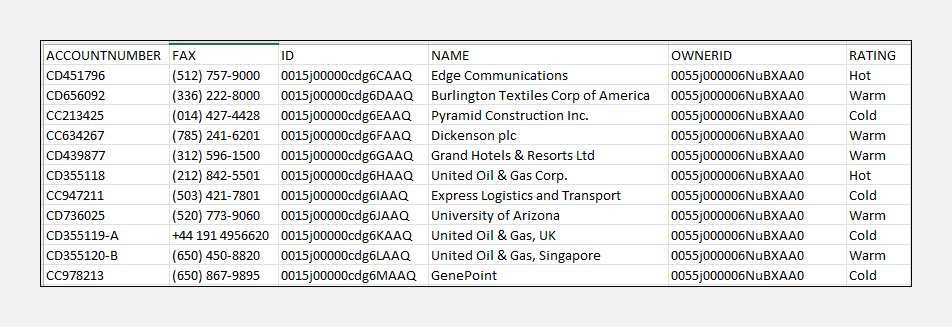
Below is a sample CSV containing 11 records for the **Account** object. Each row includes six fields. You may include additional fields based on your data needs. Fields omitted from the CSV will not be updated.
---
# Agent Instructions
This documentation is published with GitBook. GitBook is the documentation platform designed so that both humans and AI agents can read, navigate, and reason over technical content effectively. Learn more at gitbook.com.
## Querying This Documentation
If you need additional information that is not directly available in this page, you can query the documentation by asking a question.
Perform an HTTP GET request on the following URL with the `ask` and `goal` query parameters:
```
GET https://knowledgebase.autorabit.com/product-guides/arm/arm-features/dataloader/preparing-the-csv-file-for-arm-dataloader.md?ask=&goal=
```
`ask` is the immediate question: it should be specific, self-contained, and written in natural language.
`goal` is what the user is ultimately trying to achieve, the reason they need the answer. Sharing it helps GitBook give you a better, more relevant answer. A goal is most helpful when it describes the outcome the user wants rather than restating the question. For example, with `ask=how do I create an API token`, a goal like `automate deployments from our CI pipeline` lets GitBook tailor the answer to that use case.
The response will contain a direct answer to the question and relevant excerpts and sources from the documentation.
Use this mechanism when the answer is not explicitly present in the current page, you need clarification or additional context, or you want to retrieve related documentation sections.